
Hi-Lo Casino UK: Rules, Payouts and Card Play
 Available in GB
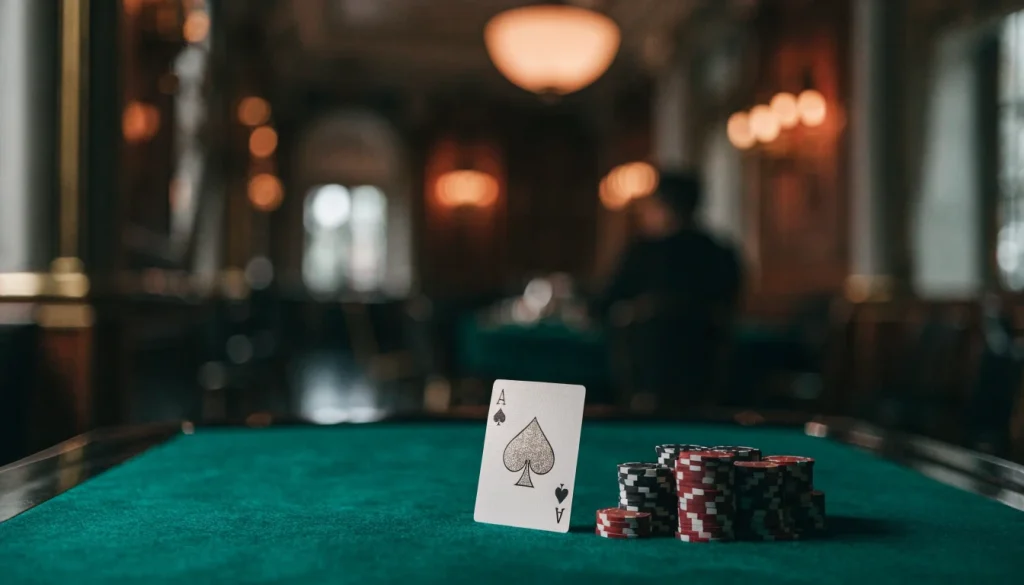
Hi-Lo rules vary by game, from tie treatment and pay tables to whether a wrong guess wipes out winnings already collected.
Table of Contents
- The Deal Behind a Higher-or-Lower Guess
- When the Cards Keep Moving: Live Hi-Lo
- A Better-Paying Guess Is Not Always the Safer One
- One Deck, No Second Appearance
- The Online Pot and the Point at Which It Ends
- Hi-Lo on a Reel Rather Than a Card
- The Arithmetic of a Finite Shoe
- A UK Hi-Lo Site Still Has to Answer to the Regulator
- Casino Games
The Deal Behind a Higher-or-Lower Guess
Hi-Lo turns a card into a small forecast. A card is revealed, and the player chooses whether the next one will rank higher or lower. Some versions add a third possibility: betting that the value will stay the same. The rule is spare; the suspense comes from having to commit before the next card appears.
A correct prediction earns a payment set by the game’s pay table. The size of that payment can depend on which direction was chosen and how likely that outcome is, so a simple choice does not mean every win is worth the same. The table gives the game its own terms.
A tie is not always treated as a loss. In versions where matching values can be chosen as a bet, that outcome is part of the wager. In other versions, a tie pushes: the stake is returned rather than paid as a win or taken as a loss. The precise treatment belongs to the particular game’s rules.
A wrong higher-or-lower guess loses the stake and ends the decision. In a continuing round, that mistake also voids any winnings already collected in that game. The next card may have been only one rank away; the wager still turns on the direction, not the distance.
When choosing a hi-lo casino in the UK for 2026, payout timing is one practical detail to check. The following verdicts stick to the information available for each operator.
1. EvoSpin
Payout speed: 1-3 business days
EvoSpin lists a payout speed of 1–3 business days.
2. x3bet
Payout speed: 1-3 business days
x3bet lists a payout speed of 1–3 business days.
3. Britsino
Payout speed: 1-3 business days
Britsino lists a payout speed of 1–3 business days.
4. WinBeast
Payout speed: 1-3 business days
WinBeast lists a payout speed of 1–3 business days.
5. Revery Play
Payout speed: 1-3 business days
Revery Play lists a payout speed of 1–3 business days.
6. SpinFormula
Payout speed: 1-3 business days
SpinFormula lists a payout speed of 1–3 business days.
7. SlotoSport
Payout speed: 1-3 business days
SlotoSport lists a payout speed of 1–3 business days.
8. NightWin
Payout speed: 1-3 business days
NightWin lists a payout speed of 1–3 business days.
9. Dieselwin
Payout speed: 1-3 business days
Dieselwin lists a payout speed of 1–3 business days.
10. BeOnBet
Payout speed: 1-3 business days
BeOnBet lists a payout speed of 1–3 business days.
That is the compact grammar of Hi-Lo: look at the exposed value, choose a direction, then let the next card settle the matter. The variations change what counts as a tie and how a round proceeds, but the central act remains an unusually public form of uncertainty. A card, a call, a consequence.
When the Cards Keep Moving: Live Hi-Lo
In a live Hi-Lo game, the previous hand does not disappear when its wager is settled. Its winning card remains visible and becomes the reference for the next round. The next decision is therefore made against a card already on display: higher or lower, with the result determined by what emerges after the deal has moved on.
That exposed card gives the table a small but important memory. In a game built around predicting what comes next, the last result is not merely history. It sets the point from which the next guess is judged. The card is familiar, but it is not available to be drawn again in that immediate calculation. The distinction matters most when the bet is more specific than simply choosing a direction.
The live format described by a specialist review uses a continuous shuffler. Cards from the preceding round are returned to it straight away, rather than remaining out of circulation for the rest of a long shoe. The visible reference card is an exception in the practical sense that it remains displayed for the next decision; the wider stream of used cards is put back into motion. The arrangement gives the game a rolling quality: a hand ends, its cards re-enter the process, and play proceeds without the accumulating history of a finite pack.
JetX Casino Game in the UK: What to Know · RTP Casino Slots UK: Understanding Long-Run Returns
A specialist review describes the game as using six decks of 48 cards, with tens removed, but also says that it could not confirm the deck count in writing. That is a description attached to that review, not a settled specification for every live Hi-Lo table. The detail is worth keeping in proportion. A table’s stated rules matter more than an assumed universal recipe, particularly where the count and composition of the cards affect how a wager is understood.
The card that stays in view
The previous winning card serves as the benchmark. A higher bet succeeds only if the next winning card ranks above it; a lower bet succeeds only if the next card ranks below it. If the same card appears, both directional bets lose. A tie is not a harmless pause in the action. It defeats either of those choices.
That is a sharper arrangement than treating an equal result as a draw that simply returns the stake. The player has chosen one side of a comparison, and equality belongs to neither side. It is a small rule with a large effect on the mood of a close call: the card can be neither higher nor lower and still settle the wager against the player.
If the same card appears, both higher and lower directional bets lose, as equality belongs to neither side.
The exposed card also places a boundary around the possible outcomes. It is not merely a convenient visual prompt. Since it is no longer in the shoe for the next decision, a bet on a proposition that would be won by drawing that very card rests on an unavailable outcome. Proposition bets require attention to that detail. Their wording may invite a player to imagine a particular card or result, but the display tells the more immediate story: one card has already been used as the reference.
This is where the live table’s visible state earns its keep. In a concealed or rapidly changing sequence, it can be easy to think only in terms of ranks and direction. Here, the reference card is physically present, a reminder that the next outcome is drawn from what remains available to that hand, not from an abstract list of possibilities. Betting against the displayed fact is still possible; expecting the displayed card to arrive again is not a sound basis for a proposition wager.
Three cards before the result
The live-style sequence also includes burned cards. Three cards are burned before the next winning card is revealed. The player’s decision is therefore not followed by an immediate display of the next card in the ordinary sense: cards are taken out of the sequence before the card that determines the result appears.
That pause changes the texture of the game without changing the central question. The wager remains higher or lower than the reference card, but there is an intervening procedure between choice and settlement. The winning card is the one that counts; the burned cards are part of the dealing process, not additional results against which the directional bet is judged.
Fruit Machine Slots in the UK: How They Work · Live Blackjack Online Casinos in the UK: What to Know
The procedure can make the round feel less like a simple turn of one card and more like a controlled reveal. There is a moment in which the choice has been made but the outcome is still withheld. The table has a reference, a wager, and then a sequence whose first visible steps do not settle the matter. The suspense is built into the order of dealing.
It is tempting to read theatrical meaning into that pause. There is no need. A burned card is not a clue about what the next winning card must be, and the fact that three are removed does not turn the game into a forecast of those cards. The practical point is narrower: the winning card appears only after that burn procedure, so the outcome should be understood by the rule that identifies the winning card, not by treating every card in the sequence as a separate Hi-Lo result.
The continuous shuffler adds another layer to this rhythm. The cards from the previous round are returned immediately, so the game does not carry forward a steadily depleted pack in the manner of a finite shoe. Yet the reference card remains exposed for the next decision, and it cannot be treated as though it were still an unseen option. The format combines circulation with a visible local memory: the broader supply moves on, while the last result remains at the centre of the next comparison.
Direction and proposition are not the same wager
Higher and lower are direct comparisons. The exposed card supplies the line; the winning card lands above it, below it, or at the same value. The third possibility is decisive because a tie makes both directional wagers lose. There is no neutral outcome for those bets.
A directional wager asks which side of the reference card the winning card will occupy, whereas a proposition wager names a more specific outcome.
A proposition bet asks something more particular about the next result. The exact menu can depend on the table’s rules, so the useful distinction is conceptual rather than a list of supposed options: a directional wager asks which side of the reference card the winning card will occupy, while a proposition wager names a more specific outcome. Specificity may make a bet sound easier to picture, but it does not make an unavailable card possible.
The exposed reference creates a straightforward check. If the proposition would win only by drawing the card already on display, that outcome is no longer in the shoe and should not be backed. It is an unusually visible constraint, the sort of detail that can be missed when attention is fixed on the printed wager choices rather than the table itself. In live Hi-Lo, the card that frames the round also rules out its own reappearance as the next winning card.
This does not mean that every proposition bet is invalid, nor does it establish how any particular table prices one. It means that the visible card must be included in the reading of the wager. A proposition is still subject to the same current state of play as a higher-or-lower choice. The table does not reset simply because the bet is phrased differently.
The distinction also explains why the same card has two roles. As a reference, it defines the comparison. As a card that has already appeared, it is absent from the possible next winning outcomes. Those roles are easy to collapse into one another: the eye sees the card and the mind keeps it available as a candidate. The mechanics say otherwise.
Video Slots in the UK: Features, Play and Bonuses · Casino Dice Games in the UK: How They Work
A moving shoe, a fixed reference
For a live Hi-Lo casino table, the continuous shuffler and exposed card can seem to pull in opposite directions. The shuffler keeps returning used cards to circulation; the display preserves the last winning card as the next round’s point of comparison. One mechanism moves the wider game forward, while the other makes each new decision visibly dependent on the hand before it.
That is the distinctive character of this live format. It is neither a wholly fresh start nor a long record of cards steadily leaving play. The previous result stays in view, but the cards from the preceding round go back into the shuffler. Three burned cards stand between the decision and the next winning card. A tie defeats a higher or lower bet, and a proposition wager cannot sensibly rely on the reference card appearing again.
For anyone assessing a live Hi-Lo casino in the UK, these are rules to read at the table rather than assumptions to carry from one version of the game to another. The label may be familiar, but the handling of the shoe determines what the visible card means, when the winning card is revealed, and how a tie is settled. The details are not decoration; they are the game.
A Better-Paying Guess Is Not Always the Safer One
Hi-Lo strategy has little room for elaborate systems. The central choice is narrower: when the game offers both Higher and Lower, compare their quoted returns and choose the option that pays more. That is the recommended approach for these bets. It is a rule about the price attached to a decision, not a promise that the decision will win.
Do
- Compare the quoted returns for Higher and Lower
- Choose the option that pays more
Don’t
- Assume a larger payout means a safer bet
- Use the payout as evidence that the game favours a direction
The distinction matters because a larger payout can make a wager look more attractive while saying nothing, by itself, about how often it succeeds. The two ideas are easy to blur. A player sees a generous figure beside one direction and may read it as evidence that the game favours that direction. But the payout and the chance of the outcome are separate parts of the wager. Without both, a payout alone cannot settle which choice is safer.
A pay table is a compact piece of social engineering. It turns uncertainty into options with visible prices, then asks the player to choose among them. The figures can look like a map of the game’s hidden order. They are not quite that. They describe what the game offers for a particular wager; they do not remove the uncertainty that made the wager possible.
A specialist review reports the game’s highest return as 96.23% when the bet is on a card higher than 4 or lower than 10. That figure belongs to the particular strategy and game description given by that review; it should not be treated as a guaranteed result or as a universal rate for every Hi-Lo game. “Highest” here is a comparison within that account, not a ranking of casinos or a claim that every version uses the same pay table.
The thresholds are worth noticing. A choice framed around being higher than 4 is not identical to one framed around being lower than 10. Each gives the player a different boundary to judge, and the quoted return attaches to those specified choices. The number does not license a broader conclusion that one direction is always better. It is tied to the wager described, rather than to a general law of Hi-Lo.
Highest RTP Slots in the UK: Understanding the Figures · Live Casino Lightning Roulette UK: Wheel and Odds
Nor does a return figure tell a story about an individual session. It cannot say whether the next decision will be correct, or whether a run of results will feel orderly. A percentage is a summary of a model, not a forecast for the next hand. In the small theatre of a card game, the next card remains stubbornly uninterested in the elegance of the arithmetic.
This is why “better-paying” and “safer” should not be used as synonyms. The recommended choice is the side with the higher quoted payout, but that instruction does not establish that the side is more likely to win. It supplies a way to compare the offered prices, not a guarantee about risk. A player seeking a lower-variance experience cannot infer it from that recommendation alone.
The same caution applies to claims about the “best” Hi-Lo game. A high stated return may be relevant when comparing the terms of a specific wager, but it does not make a casino the best place to play. That would require a separate comparison of operators and their conditions, not just one figure attached to a betting choice. The wager is the proper subject here; a site’s standing is another matter.
There is a quiet discipline in reading such numbers literally. The 96.23% return is informative because it is attached to defined choices: higher than 4 or lower than 10. Detached from those terms, it becomes a decorative percentage, liable to be mistaken for a general promise. Attached to them, it remains useful but bounded: a stated return for a particular approach, not a forecast of personal results.
Practical Strategy
Select the Higher or Lower payout that is higher, but treat reported maximum returns as specific to the game description.
So the practical strategy is modest. Compare the Higher and Lower payouts where both are available, and select the one that pays more. Treat the reported maximum as specific to the game description behind it. The arithmetic can rank the offered prices. It cannot make an uncertain wager safe.
One Deck, No Second Appearance
Draw Hi-Lo is built around a finite supply: one deck of 52 cards. Aces sit at the bottom of its value order, rather than switching between low and high. That convention gives each card a fixed place in the game’s hierarchy, and keeps the comparison straightforward even as the deck is used.
The more consequential rule is that a card, once played, does not go back into the deck. A revealed card is not merely a momentary reference point; it has left the available pool. No card can make a second appearance during the same game.
That changes the texture of a run. In a game with a continually replenished supply, each new decision can be treated as a fresh encounter with the same possible values. Here, the deck is gradually depleted. The history of what has appeared is part of the present, whether or not a player is actively tracking it. The game has a memory, of sorts, but it is a material one: the missing cards.
The distinction is easy to overlook when attention is fixed on the next guess. Yet a finite deck makes each sequence particular. A card that has already appeared cannot return to surprise anyone; the remaining choices are drawn from what is still there. This does not make the next card predictable in any absolute sense. It does mean the game is not simply repeating the same conditions at every turn.
Chicken Road Casino Game in the UK: What Is Known · Progressive Slots Online in the UK: How Jackpots Work
Aces-low is another small rule with a large effect on how the cards are read. An ace is not a high card waiting to become low when convenient. Its value is settled at the low end. That consistency matters in a game whose decisions depend on ordering: the card’s identity and its position do not change to suit the moment.
The single-deck format also places a boundary around a game. Once cards have been used, they remain outside it; the deck is not silently refreshed between decisions. A player is therefore dealing with a changing collection, not an endless stream in which every value remains available. The apparent simplicity of “higher or lower” rests on that more specific arrangement.
This is separate from live-style Hi-Lo, where a continuous shuffler returns cards to circulation. Draw Hi-Lo’s defining feature is the opposite: used cards stay used. The difference is not cosmetic. One format restores the supply as play proceeds; the other lets each appearance narrow what remains.
A small pack, a fixed order, no second appearance. The rule is severe in its own quiet way.
The Online Pot and the Point at Which It Ends
In online Hi-Lo, a round is measured not only by the card on screen but by the pot that grows beside it. The player sees a card, then chooses whether the next one will rank higher or lower. The values run from ace at one point to king at thirteen, giving each reveal a place on a simple ladder. The interface may make that ladder look almost self-explanatory. Its consequences are less decorative.
Card Value Hierarchy
The values in online Hi-Lo run from ace at one point to king at thirteen, forming a simple ladder for each reveal.
A correct prediction adds winnings to the pot. The player can then make another decision, risking the progress already made for the possibility of adding more. Or the round can end: after the first decision, the player may stop at any point and collect the winnings accumulated so far. The game therefore has two kinds of finish. One is chosen, with the pot secured; the other arrives through a wrong call.
On an incorrect guess, the money placed on that decision is lost, and the winnings collected during that game are also void. A rising pot is not a balance held safely in reserve. It is a record of success that remains exposed for as long as play continues. The stop option matters because it turns each correct answer into a small negotiation between continuation and collection. No elaborate strategy is needed to understand the tension. The arithmetic is visible; the appetite is not.
There is a practical complication in descriptions of the online format: they do not agree on the cards behind the display. One account describes a single 52-card deck, with used cards kept out of play; another describes six 48-card decks, continuously shuffled. Those are materially different arrangements. In the first, each revealed card changes what remains available during that game. In the second, the stated continuous shuffle implies a different relationship between one decision and the next. The neatness of the screen does not settle the disagreement.
That difference should not be mistaken for a change in the visible task. The decision still concerns whether the next card will be higher or lower than the current one, and the pot still records the consequence of correct guesses. But the card supply shapes what “next” means beneath the interface: either a card drawn from a diminishing set or a result emerging from a replenished one. A game can present the same small choice while resting on different machinery.
Plinko Casino UK: Licensing, Free Play and Payments
The online format’s drama is unusually compact. A card appears, a direction is chosen, and the pot either grows or the run ends with its accumulated winnings gone. Stopping is not a side feature; it is the point at which the player converts a precarious sequence into a completed one. Continue, and the total remains vulnerable. Collect, and the round is over.
A modest machine. A sharp little bargain.
Hi-Lo on a Reel Rather Than a Card
In this version, Hi-Lo leaves the card table behind. The choice remains familiar—higher or lower—but its outcome comes from a reel rather than a card drawn from a deck. A specialist review describes a single reel on which the player selects a direction before it stops.
The bet wins if the reel lands on a number in the chosen direction. A number in the opposite direction loses, and a tie also counts as a loss. That makes the tie less forgiving than in some card games, where matching values may have a different consequence. Here, the reel’s stopping point settles the wager without a second card or a running sequence of exposed cards.
The change in equipment changes the feel of the decision. A card game invites attention to ranks and to what has already appeared; a reel presents a compact result, then leaves little to interpret. The central act is still a directional guess, but the mechanism turns it into a wager on where the display will stop.
Reel Hi-Lo Sequence
Step 1: Directional Guess
The player selects a direction (higher or lower) before the reel stops.
Step 2: Result Settlement
The bet wins if the reel lands on a number in the chosen direction; a tie or opposite direction results in a loss.
Step 3: Post-Win Decision
The player chooses to either collect the winnings or parlay the stake and winnings into a further round.
After a win, the player faces another choice. A specialist review describes two paths: collect the winnings and begin again, or parlay the original stake together with the winnings into a further round. Collecting closes the run with the amount already secured. Parl laying—putting both stake and winnings back into play—keeps the sequence alive, while exposing the accumulated result to another outcome.
There is no card count to follow here, and the round does not depend on a finite deck being depleted. Its rhythm is simpler: choose a direction, watch the reel stop, then decide whether a win ends the session or funds another attempt. The apparent simplicity is part of the design. One motion, one result, one more decision.
The Arithmetic of a Finite Shoe
A Hi-Lo game with a finite deck changes as it proceeds. In the single-deck description, the pack contains 52 cards and used cards stay out of play. Each reveal therefore alters the set of cards that could follow. A player tracking what has appeared is working with a different probability picture from one facing a freshly replenished pack.
That distinction matters when published returns are read. A specialist review gives a return of 96.07% for basic strategy and 100.36% for card counting. These are figures attached to a particular analysis, not guarantees of what a session will produce. The card-counting figure exceeds the original stake in theoretical return, but that does not mean a player can expect to finish ahead: the result describes the model’s calculated expectation, while individual rounds remain uncertain.
Online Bingo UK: Tickets, Rooms and Slot Games
The method also depends on the game being analysed. Sources disagree about the format: one description specifies a single 52-card deck with no cards returned, while another describes six 48-card decks and continuous shuffling. Those are materially different conditions. In a finite shoe, past cards change the remaining composition; with continuous shuffling, the previous round’s cards are returned to the mix. A return calculated for one arrangement should not be carried across to the other as though the machinery were incidental.
Card counting, then, is not a secret way to make a guess certain. It is an attempt to use the changing composition of a particular deck to assess how the available choices have shifted. Its usefulness rests on knowing which cards remain relevant and on the game actually preserving that information. A continuously shuffled game does not offer the same finite sequence to track.
The figures are striking, especially the one above the stake. But arithmetic is only as portable as its assumptions. A number attached to a single-deck analysis cannot settle the prospects of every Hi-Lo casino game, still less turn a changing run of cards into a promise. The shoe matters. So does the table’s account of it.
A UK Hi-Lo Site Still Has to Answer to the Regulator
A Hi-Lo casino may present itself as a small diversion: a card, a guess, a result. Legally, however, an online game sits inside a much larger arrangement between a gambling business and the state. In Great Britain, the UK Gambling Commission regulates commercial gambling, including online casinos, and is the sole regulator for that activity. Its reach is not limited to businesses whose servers or other key equipment happen to sit on British soil. A remote operator offering gambling to consumers in Great Britain falls within the Commission’s remit wherever that equipment is located.
Licensing Risk
Remote gambling businesses serving Great Britain must hold a relevant UK Gambling Commission licence; an overseas licence is not a substitute.
That principle matters when considering Hi-Lo casino sites in the UK. A polished interface, a familiar game name or a claim of overseas authorisation does not make an operator part of the British regulatory system. Remote gambling businesses serving Great Britain need the relevant UK Gambling Commission licence. Offshore casinos without one sit outside that system; an overseas licence is not a substitute for the British authorisation required to serve this market.
What the licence covers
The Commission’s licensing framework distinguishes between the business and the people who perform certain roles within it. It grants operating licences to gambling businesses and personal licences to individuals working in relevant positions. The point is institutional as much as administrative: responsibility does not dissolve into a website’s graphics or software. There is a licensed operator behind the gambling service, and named individuals may also be subject to licensing.
The Gambling Act 2005 governs gambling in England, Wales and Scotland, though not Northern Ireland. The Commission’s role described here concerns Great Britain, and its oversight of remote gambling follows the consumer market rather than the physical location of the equipment. “Online” does not mean legally weightless. Nor does a foreign address make the British rules disappear.
For players, the practical distinction is between a casino that holds the appropriate current UK operating licence and one that does not. Online gambling is legal in the UK at licensed and regulated sites, for people aged eighteen and over. Operators must verify a customer’s age before allowing a deposit. A Hi-Lo game may be brief; the obligations around offering it are not.
Checking the status, not the sales language
Before depositing, the operator’s licence number should be checked against the UK Gambling Commission’s public register. That is more useful than relying on a badge displayed on a casino page: a badge is a claim made by the site, while the register is the regulator’s record. The business name and licence details should correspond. A mismatch is not a cosmetic quibble.
High-Volatility Slots in the UK: How They Work
A licence does not mean that every game will suit every player, or that every outcome is favourable. It means the operator is answerable within a regulatory framework. That framework requires UK-licensed casinos to provide responsible-gambling tools, including self-exclusion, and requires remote operators to prompt new customers to set a financial limit before their first deposit while making account-level limit controls accessible. These are not decorative settings. They are part of the conditions under which gambling is offered.
The rules also shape what happens when a dispute arises. UKGC licensees must have an internal complaints process and provide access to an approved Alternative Dispute Resolution service. The process gives a complaint a route beyond the casino’s own customer-service desk. It does not guarantee a preferred outcome, but it establishes that disagreement is not meant to end with the operator simply closing the conversation.
Operators are also required to contribute to the Research, Education and Treatment levy. That obligation reflects a wider public choice: gambling is permitted as a commercial activity, but its costs are not treated as a private matter belonging only to the person at the screen. Regulation is the price of that permission. A dry bargain, perhaps, but a bargain nonetheless.
Classic slots online in the UK: free-play guide
A market with boundaries
The UK Gambling Commission’s authority is not a general endorsement of every site that mentions Hi-Lo, nor does it regulate every gambling service everywhere in the United Kingdom in precisely the same legal setting. The Gambling Act’s territorial scope and the Commission’s Great Britain remit matter. For a remote casino serving consumers in England, Scotland or Wales, however, the licensing requirement is central: the operator must hold the relevant Commission licence, even if its equipment is elsewhere.
That is why the question of a UK Hi-Lo casino site is not settled by the game itself. The cards may be identical across two websites; the legal relationship is not. A current operating licence places a casino within the British system of oversight, complaints handling and player protections. Without it, the site is outside the UKGC framework. The distinction is less colourful than the game. It is also the one that counts.
Casino Games

Aviator Casino Game UK: Rules and Licensing
The guide separates UKGC-licensed operators from offshore sites and explains what game, bonus and payment...

3-Reel Slots in the UK: Format and Play
Three-reel games use a compact layout whose symbols, pace and features shape the experience of...

Five-Reel Slots in the UK: How They Work
A practical look at screen layout, demo play, bonus timing and the limits of what...

Bonus Buy Slots in the UK: How They Work
A guide to in-game bonus access, slot variance, demo play and the UK rules that...
UK casino fast payouts: keno awards vs withdrawals
A game’s paytable explains awards for qualifying results, but it cannot show how quickly a...

First Deposit Casino Bonuses in the UK: Key Terms
The offer sits within a regulated account, where deposits, identity checks and bonus conditions shape...

High-Volatility Slots in the UK: How They Work
High volatility means wins tend to be less frequent and larger, but it cannot predict...

Online Keno Casinos in the UK: Games and Rules
Keno combines selected numbers with a random draw, while the paytable determines how matching picks...

Live Casino UK: Tables, Games and Offers
A practical guide to live-dealer formats, blackjack decisions, lobby design and the terms attached to...

Low-Volatility Slots in the UK: How They Work
Low volatility describes how returns are distributed across play, not a guarantee of frequent wins...

Best Online Slots Payout Percentages: What RTP Means
A payout percentage describes an average over play, not a guaranteed result for an individual...

Progressive Jackpot Slots: How the Prizes Grow
Wager contributions feed progressive pools, while ordinary slot payouts follow a separate path and jackpots...

RTP Casino Slots UK: Understanding Long-Run Returns
RTP combines a game's probabilities and payouts into a long-run measure, while individual results can...

Highest RTP Slots in the UK: Understanding the Figures
RTP describes a theoretical return across a very large volume of play, not the result...

Video Slots in the UK: Features, Play and Bonuses
A clear guide to reel formats, game features, browser and mobile play, bonuses, and the...
Casino Dice Games in the UK: How They Work
Dice-themed casino play is a wager on chance, where the visible roll does not reveal...

Chicken Road Casino Game in the UK: What Is Known
A look at how casino games, demo and cash play, bonuses and UK casino offers...

Classic slots online in the UK: free-play guide
Free demos make it possible to explore reel layouts, symbols, controls and features without placing...

Crash casino games in the UK: licensing and play
Crash games may be available to UK players without the casino being part of the...
Crazy Time Live Casino Game Show in the UK
A human-run studio streams the game in real time, while players place bets through an...

Deal or No Deal Casino UK: How the Game Works
The casino adaptation follows a game-led route into a decision stage, unlike the contestant-led television...

Fast Payout Online Casinos UK: How Speed Is Measured
A withdrawal can involve a request, casino review and separate payment transfer, so a single...
French Roulette Online Casinos in the UK
La Partage, En Prison, wheel formats and wager terms shape how French roulette differs at...

Fruit Machine Slots in the UK: How They Work
A guide to UK fruit slots, from familiar symbols and game mechanics to free demos,...

JetX Casino Game in the UK: What to Know
A guide to JetX’s slot label, demo limits, bonus terms, UK licensing context and the...

Live Casino Lightning Roulette UK: Wheel and Odds
A clear look at how wheel layouts, the zero and online play shape the experience...

Live Baccarat Online Casinos in the UK
Live baccarat combines a human-dealt game streamed from a studio with an interface for placing...

Live Blackjack Online Casinos in the UK: What to Know
See how the dealer, physical deck, table rules and bonus terms shape the experience—and why...

Live Dream Catcher Casino UK: How It Works
A look at the live studio, betting controls, physical wheel and practical limits of playing...

Live Roulette UK with English-Speaking Dealers
A clear guide to the streamed physical wheel, digital betting controls, roulette bets, odds and...

Mines Casino Game in the UK: Rules and Risks
A guide to Mines’ place in online gambling, the limits of demo play and the...

Monopoly Live casino in the UK: format and play
The branded game combines a studio stream with software-driven betting, so its rules, connection quality...

Online Bingo UK: Tickets, Rooms and Slot Games
Learn how ticket formats shape wins, how bingo differs from slots, and what to consider...

Online American Roulette in the UK: The Extra Zero
American roulette’s single zero and double-zero shape the possible outcomes, while the table format and...
European Roulette Online in the UK: Rules and Odds
A clear guide to the single-zero wheel, bet types, payouts and the differences between RNG...

Online Casino Games for Real Cash in the UK
A practical look at how line selection changes spin costs and how casino rules affect...

Online Casino Tournaments UK: Free Entry Explained
A freeroll removes the tournament admission charge; tickets and buy-ins describe other ways an event...

Online Casinos Without ID in the UK: What to Know
A “no ID” sign-up claim does not remove the identity checks required of UK-licensed casino...

Penny Slots in the UK: Stakes, RTP and Free Play
Explore how minimum stakes, paylines, RTP and bonus terms shape the experience of playing penny...

Plinko Casino UK: Licensing, Free Play and Payments
The guide separates UKGC-regulated casinos from offshore platforms and explains how free play, bonuses and...

Progressive Slots Online in the UK: How Jackpots Work
A practical explanation of shared prize pools, jackpot triggers, odds, free-play terms and the protections...

UK Casino Sites and Online Slots: What to Check
A practical comparison of game information, returns, bonuses, access and the rules surrounding real-money slot...